Articles
Best Time to Visit Madinah: Weather, Crowds & Prices
Osama Naseer · 30 October 2026 · 11 min
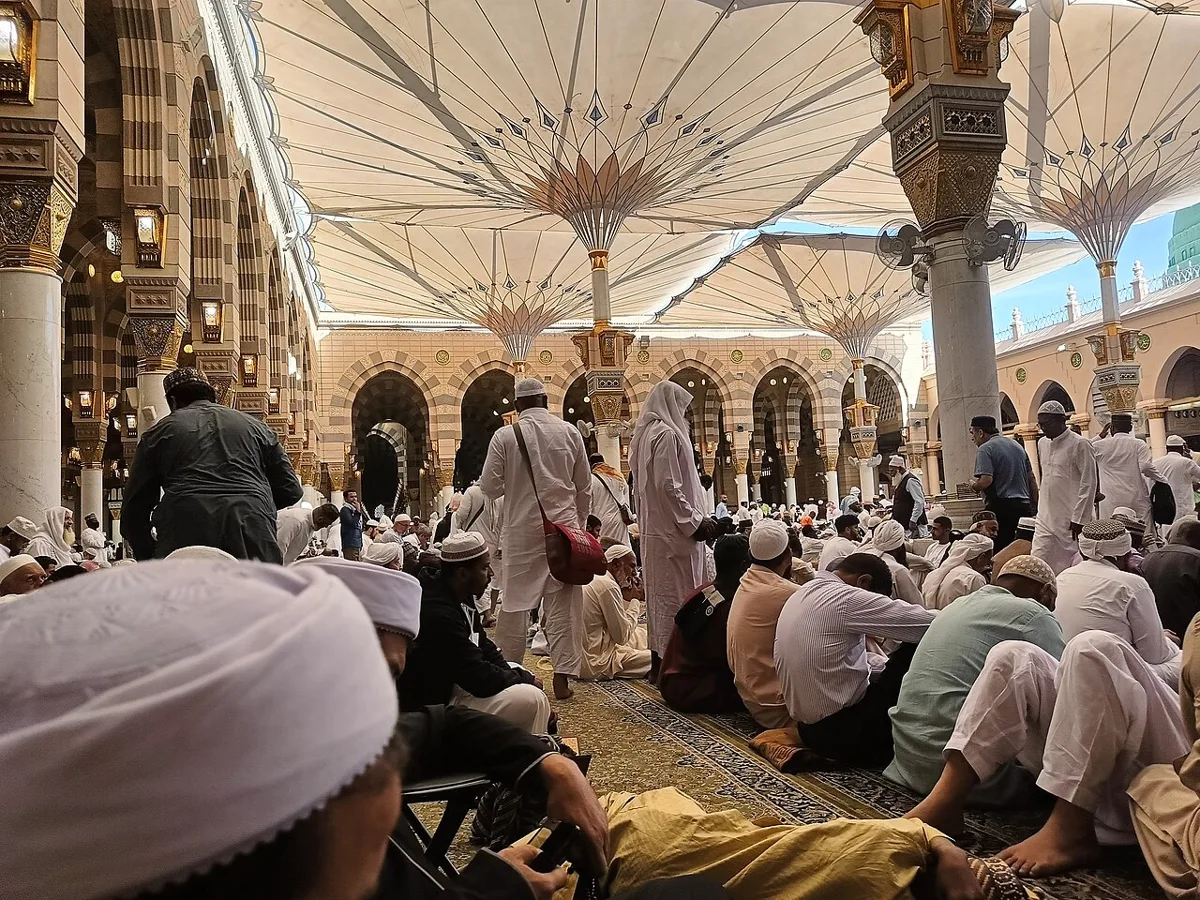
For most visitors, the best time to visit Madinah is November to January, when average highs are 24–30°C and you avoid both summer heat and Ramadan crowds. Ramadan is the most rewarding time spiritually, but also the busiest and among the most expensive, and in 2027 it starts around 8 February. If your budget is the main concern, the city-wide figures below point to summer as the cheapest period, but average highs then reach 43–44°C. Here is how weather, crowds and prices compare through the year, so you can pick what suits you.
The quick answer by season
| Season | Weather | Crowds | Hotel demand | Good for |
|---|---|---|---|---|
| Nov–Jan | Mild to cool | Busy | Fairly high | First-timers, elderly travellers |
| Ramadan (Feb–Mar 2027) | Pleasant | Peak | Peak | Taraweeh, worship, atmosphere |
| Apr–May | Hot, getting hotter | Lower, then Hajj | Varies | Pre-Hajj visitors, those who plan well |
| Jun–Sep | Extreme heat | Still large | Lowest rate we found (Q3) | Budget travellers, date season |
| Oct | Hot, easing | Rising | Rising | Those happy with warm days |
Madinah weather month by month
Madinah has a hot desert climate, and because the air is dry, shade makes a real difference. The temperatures below are 1991–2020 averages published by the World Meteorological Organization. Humidity is a modelled figure from NASA data via Climate-Zone.
| Month | Avg high | Avg low | Rain | Humidity | What it feels like |
|---|---|---|---|---|---|
| January | 24°C | 12°C | 9 mm | 41% | Mild days, cold at Fajr |
| February | 27°C | 14°C | 3 mm | 35% | Very pleasant |
| March | 31°C | 17°C | 5 mm | 27% | Warm, still comfortable |
| April | 36°C | 22°C | 7 mm | 23% | Hot by midday |
| May | 40°C | 26°C | 5 mm | 18% | Very hot |
| June | 43°C | 29°C | 0 mm | 13% | Extreme daytime heat |
| July | 43°C | 30°C | 1 mm | 17% | Extreme daytime heat |
| August | 44°C | 31°C | 4 mm | 18% | Hottest month |
| September | 42°C | 29°C | 0 mm | 15% | Extreme, easing slowly |
| October | 37°C | 24°C | 5 mm | 21% | Hot days, warm nights |
| November | 30°C | 18°C | 14 mm | 35% | Comfortable |
| December | 26°C | 14°C | 7 mm | 42% | Mild, cool evenings |
Rounded. Climate sources disagree on rainfall, with annual totals from about 50 to 92 mm, but all show a very dry city. For this week’s forecast, see Madinah weather.
The record high is about 49°C, reached in summer. Extremes still happen: Saudi forecasters reported 47°C in Madinah in August 2024 and again forecast it in August 2026. Rain is rare but can be intense. In November 2025, a red alert was issued for rain in Madinah, and the mosque’s courtyard was soaked. In September 2026, thunderstorms arrived with temperatures of 44°C. So even in a dry city, check the forecast and take warnings seriously.
Season by season
Winter (December–February): the most comfortable
Walking is easy, so this is the best time for trips on foot along the Quba Walkway to Quba Mosque, or for an outing to Mount Uhud and Uhud Park. Fajr can feel genuinely cold, at around 12–14°C, so pack a warm layer, particularly if you sit on the marble outside. Remember that in 2027 and 2028, Ramadan falls in or near this period. The Madinah Winter Season also ran a programme of events in March 2026, including a Cultures and Peoples Festival from 29 March to 6 April, so check what is on.
Spring (March–May): warming quickly
March is still pleasant, but by May the average high is about 40°C. In 2027 this stretch includes the end of Ramadan, Eid al-Fitr and the run-up to Hajj, so check the key dates below before you book anything.
Summer (June–September): extreme heat, lower prices
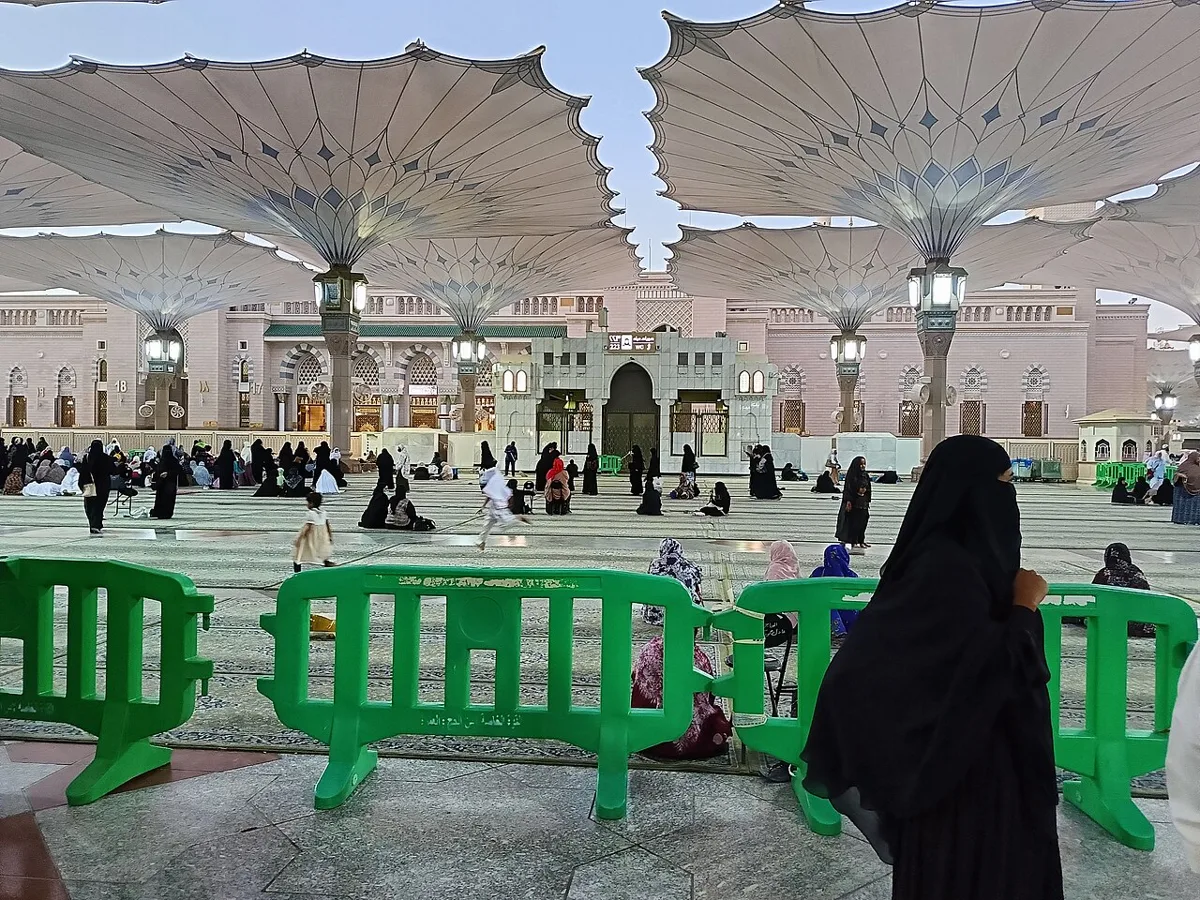
Average highs are 42–44°C, and humidity is low, so sweat dries fast and you may not notice how much water you are losing. Plan outdoor visits for dawn or after sunset, and rest at midday. The World Health Organization advises about one cup of water per hour, or at least 2–3 litres a day, in extreme heat, and limiting strenuous activity at the hottest time. Saudi Arabia’s Ministry of Health says that umbrellas reduce the risk of heat exhaustion and lower the surrounding temperature by about 10°C. So carry one, and use the shade of the mosque’s piazza umbrellas.
The upside is that this is date season, with the harvest peaking in July and August. See our guide to the types of dates in Madinah.
Autumn (October–November): easing off
October is still hot, with highs around 37°C. November is one of the best months overall, with highs near 30°C and pleasant evenings for a stroll in King Fahd Central Park. It is also the wettest month on average, though that still means only about 14 mm.
Key dates for 2027 and 2028
Crowds follow the Islamic calendar, which moves about 11 days earlier each year. These are expected dates based on Saudi Arabia’s Umm al-Qura calendar. The actual dates depend on the official moon sighting, so confirm them before you book anything you can’t change.
| Event | Expected date | What it means for you |
|---|---|---|
| Ramadan 2027 | About 8 Feb – 8 Mar 2027 | Peak crowds, especially the last 10 nights |
| Eid al-Fitr 2027 | About 9 Mar 2027 | Book very early |
| Last Umrah visa issued | 9 Mar 2027 | Announced for the 1448 season |
| Last entry on Umrah visa | 23 Mar 2027 | Announced for the 1448 season |
| Umrah visa holders must leave by | 7 Apr 2027 | Announced for the 1448 season |
| Day of Arafah 2027 | About 15–16 May 2027 | Hajj season |
| Ramadan 2028 | About 28 Jan – 25 Feb 2028 | Moves earlier again |
The Umrah visa dates were reported by Gulf News in May 2026. Confirm them on the official Nusuk platform before booking.
This matters when you plan a trip after Ramadan 2027: if you are on an Umrah visa, you only have about a month after Eid before the cut-off. See our guide to apps for Umrah pilgrims for how Nusuk permits work.
Can you visit Madinah during Hajj season?
Rules tighten sharply around Hajj, mainly for Makkah. In 2026, Umrah visa issuance stopped on 20 March, and Umrah visa holders had to leave by 18 April. Makkah entry was restricted from 13 April, and Nusuk Umrah permits were suspended from 18 April to 31 May. We found no official statement on access to Madinah itself in that period. One travel source says that the city stayed open to tourist and Umrah visa holders, with heavier crowds and checks, but that is not official. Check the current rules on the Nusuk platform, linked on our downloads page, before planning a trip around this time.
How busy does it get?
Official figures from the General Authority for the Care of the Two Holy Mosques give a clear sense of scale. These are counts of prayer entries, not individual people, so one person praying five times a day is counted several times.
| Period | Prophet’s Mosque entries | Rawdah prayers | Average per day* |
|---|---|---|---|
| Ramadan 1447 (2026), first 10 days | 10,789,467 | 317,025 | About 1.08 million |
| Ramadan 1447 (2026), first 20 days | 21,143,259 | 579,191 | About 1.06 million |
| All of Ramadan 1446 (2025) | 30,154,543 | Not found | About 1 million |
| Jumada I 1447 (Oct–Nov 2025) | 23,296,185 | 912,695 | About 780,000 |
| Muharram 1447 (Jun–Jul 2025) | 21,576,200 | 1,122,368 | About 720,000 |
| September 2026 | 21,615,977 | 1,449,791 | About 720,000 |
*Our own calculation, using 29–30 days a month. Figures from Asharq Al-Awsat, Gulf News and the Saudi Press Agency.
Two points stand out. First, Ramadan is roughly 30–50% busier per day than the ordinary months shown. Second, those ordinary months are not quiet, because the mosque draws more than 700,000 entries a day. Even more interesting, there were fewer Rawdah prayers per day in early Ramadan than in September 2026, so a busy mosque does not automatically mean more Rawdah access.
National Umrah figures show a seasonal pattern too. Saudi Arabia’s General Authority for Statistics reported 15.2 million Umrah performers in Q1 2025, which included Ramadan, then 5.4 million in Q2, when Hajj restrictions apply, and 11.3 million in Q4. Madinah visitors reached 6.45 million in Q1 2025 and 5.72 million in Q4 2025. So late autumn and winter are comfortable, but they are far from empty. We did not find an official month-by-month pattern.
When are hotels cheapest?
We found no official month-by-month rate card, but quarterly figures show the pattern. These are city-wide averages, and hotels close to the mosque will cost far more.
| Period | Occupancy | Average daily rate | Source |
|---|---|---|---|
| Q3 2025 (summer) | 68.9% | SAR 298 | GASTAT via Argaam |
| Q1 2026 (includes Ramadan) | 84.0% | SAR 471 before VAT | GASTAT via Omran |
| Q2 2026 (includes Hajj period) | Reports conflict | SAR 589 | Argaam |
| 2025, full year | 75% | Not comparable | Almqr report |
Sources use different methods, so treat these as a guide and not a direct comparison.
On these figures, Q3, the summer quarter, had the lowest rate we found by a wide margin. Every month of Q1 2026 was above 81% occupancy, so even January and February were not cheap. JLL’s data also attributes Q1’s strength to Umrah demand and Ramadan travel.
What should you do with this? If comfort matters more, pay the higher winter rate. If cost matters more, and you can handle the heat, go in summer, stay close to the mosque so you walk less in the sun, and use the money saved on a better room. To check your own dates, start with our Madinah hotels list, then compare the live price on each hotel’s page. If you are staying a long time, look at how far you can comfortably walk: nearly all hotels on our list are within 1 km of the mosque, and the closest is about 80 metres away.
School holidays that affect crowds
Saudi school breaks bring domestic visitors. A published calendar for the western region, which covers Madinah and cites the Ministry of Education, shows the following for 2026–27. We read it through a travel site rather than from the Ministry, so check before relying on it.
- Autumn break: 20–28 November 2026
- Mid-year break: 8–16 January 2027
- Eid al-Fitr break: 26 February – 13 March 2027
- Eid al-Adha break: 30 April – 22 May 2027
- School year ends: 1 July 2027
School holidays in your own country, as well as those in other countries that send many pilgrims, add to these peaks. So a mid-week trip in early December or late January looks like a good choice, on what we can tell.
The best time to visit Madinah for your situation
| You are… | Best time | Why |
|---|---|---|
| Travelling with elderly parents | Late Nov – Jan, outside school breaks | Mild weather makes walking easier |
| Visiting for the first time | Nov – Jan | Comfortable and easier to find your way around |
| Seeking the Ramadan atmosphere | Ramadan, booked early | Taraweeh and a real sense of community |
| Travelling with children | Your winter or spring school break | Avoids peak heat |
| On a tight budget | Summer, if your health allows it | The lowest city-wide rate we found |
| A date lover | July – September | Harvest and fresh dates |
| Only free in summer | Go, and plan around the heat | Dawn and night are workable |
What to pack for each season
The right clothes make a bigger difference here than most people expect, because you will spend long stretches walking to and from the mosque, and sitting on marble or carpet between prayers.
- November to February: pack a warm layer for Fajr and late evenings, when temperatures can fall to around 12–14°C, plus socks for cold marble. Daytime is still sunny, so bring sunglasses too.
- March to May: choose light, loose clothing, with one thin layer for air-conditioned spaces. A small umbrella and a refillable water bottle become useful from April onwards.
- June to September: wear loose, breathable clothes, and carry an umbrella, a water bottle and sun protection. Very low humidity can dry out your lips and skin, so pack lip balm and moisturiser.
- All year: bring comfortable shoes that are easy to slip off, and a small bag to carry them in at the mosque.
How to plan once you have your dates
- Check the expected Islamic dates above against your travel dates.
- Confirm the visa rules on Nusuk for your dates.
- Book your hotel early if your dates are in Ramadan or a school break.
- Read about how to get to Madinah and how to get from the airport to the mosque.
- Check prayer times so you can plan your days around them.
- Read our first visit guide, and preview the mosque with our virtual tour.
Frequently asked questions
❓What is the best month to visit Madinah?
November, December and January suit most visitors, with average highs of 24 to 30 degrees Celsius. In 2027 most of February falls in Ramadan, so choose January if you want mild weather without the Ramadan crowds.
❓What is the cheapest time to visit Madinah?
On the city-wide figures we found, the summer quarter (Q3) had the lowest average hotel rate, about SAR 298 in 2025, compared with SAR 471 in Q1 2026. Summer is also extremely hot, and hotels near the mosque cost more.
❓How hot does Madinah get?
August is the hottest month, with an average high of about 44 degrees Celsius. The record is about 49 degrees.
❓Does it rain in Madinah?
Rarely. Annual rainfall is well under 100 mm, but storms can be intense, and red alerts have been issued, as in November 2025.
❓When is Ramadan in 2027?
It is expected from about 8 February to 8 March 2027, based on the Umm al-Qura calendar. The actual dates depend on the moon sighting.
❓Is Madinah crowded all year?
Largely, yes. Official counts show more than 700,000 prayer entries a day at the Prophet's Mosque in ordinary months, rising to about one million a day in Ramadan.
How we checked this article: we used World Meteorological Organization climate data, the General Authority for the Care of the Two Holy Mosques as reported by Asharq Al-Awsat and Gulf News, the General Authority for Statistics (GASTAT), JLL, Argaam, Khaleej Times, the WHO and Saudi Arabia’s Ministry of Health. Calculations marked as ours are simple averages. Last checked 30 October 2026.
Related reading
Madinah Airport to Masjid an-Nabawi: Taxi, Bus & Transfers
Madinah airport to Masjid an-Nabawi: the official SAR 75 taxi fare, the 24-hour Route 400 bus, Uber and Careem, travel times, and which option suits you.
Top 10 Types of Dates in Madinah and How to Choose Them
The 10 types of dates in Madinah compared: Ajwa, Safawi, Mabroom, Sukkari and more, with taste, size and price, plus tips on how to buy well.
#Planning #Weather #Ramadan #Hajj